Etching, and what cleaning cannot fix
The most useful page on this site, because it covers the damage people spend money trying to clean off. Etching is not a stain and it does not come out.
Calls answered 7am to 8pm · same-day service usually available
Send a photo and we will tell you whether it is a stain or an etch before anybody visits.
What etching actually is
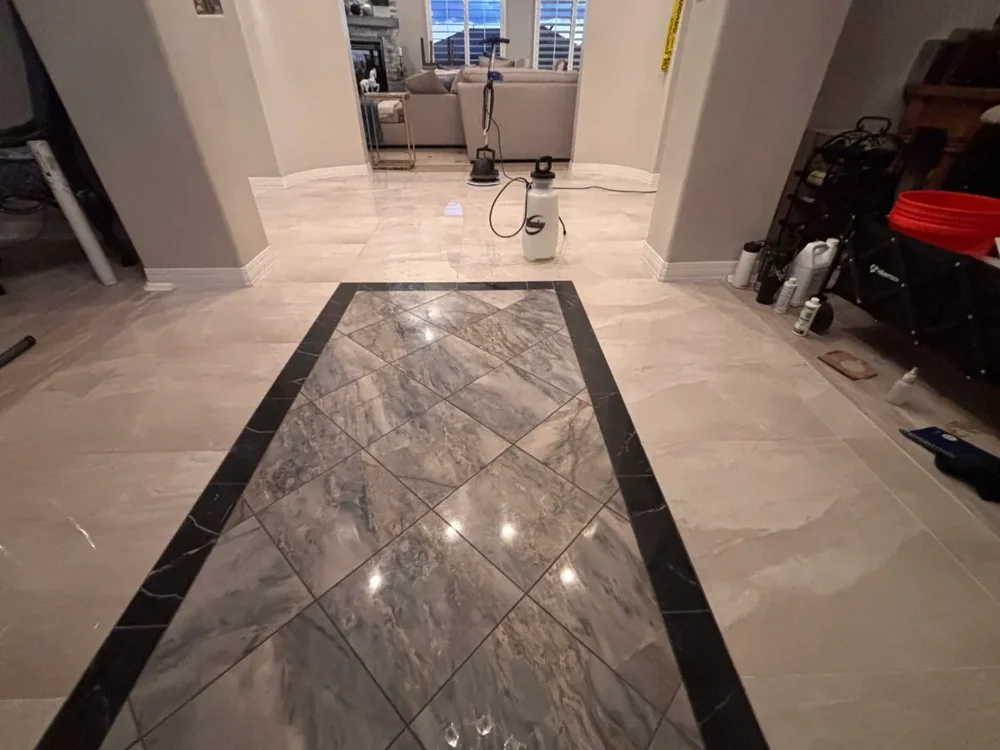
Marble, travertine and limestone are calcium carbonate. Acid dissolves calcium carbonate. That is the entire mechanism and it is a chemical reaction rather than a cleaning problem.
When something acidic sits on the stone, it eats a microscopic layer off the surface. What is left is duller than the stone around it, because the smooth polished or honed surface has been removed and replaced with a rougher one.
It is worth sitting with what that means. The stone is not dirty in that spot. There is nothing sitting there to remove. The surface itself is gone, and cleaning a hole does not fill it in.
How to tell etching from a stain
People frequently spend months trying to clean an etch, so this is worth knowing.
A stain is darker than the surrounding stone, because something has soaked in. It usually darkens further when wet.
An etch is duller, not darker. On polished stone it reads as a matte patch where the reflection has gone. Wet it and it looks much the same, because there is nothing absorbed to darken.
Run a finger across it. An etch frequently has a slightly different texture, a faint roughness against the polish around it.
What causes it, and the list is longer than people expect
Food and drink
Wine, citrus of any kind, tomato, vinegar, coffee, most sodas. Anything that would taste sharp is acidic enough to etch.
Cleaning products, which cause most of it
This is the one nobody sees coming. Most general-purpose bathroom cleaners are acidic. So is almost anything marketed for soap scum, hard water or lime scale, which in this climate is exactly what people reach for.
Vinegar in particular gets recommended constantly as a natural cleaner, and on a marble floor it is one of the worst things you can put on it.
Other companies
We find etching that was put there by cleaning services, and it is not rare. A company that treats a stone floor like a tile floor, using the same acidic product that shifts hard water off ceramic, will etch travertine on the first pass.
What we do about it, which is tell you
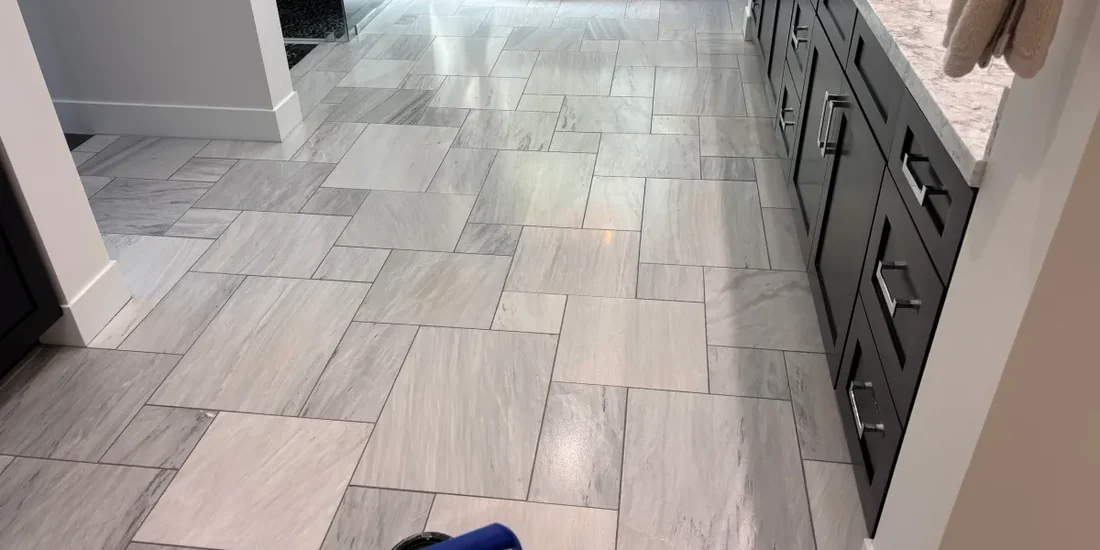
Removing etching means honing and polishing the stone with diamond pads, cutting the surface back until it is level and then rebuilding the finish. That is refinishing, it is a genuine skill, and it is not what we do.
We clean and seal. Those are different trades that get confused because both involve somebody kneeling on a stone floor.
When what your floor needs is a refinisher, we will tell you that instead of taking the job and leaving you disappointed.
What cleaning and sealing does achieve on an etched floor is worth stating too. Everything except the etch marks improves, frequently substantially, and on a floor with a handful of etches in a large area that can be exactly the right answer. The marks remain and the floor around them looks considerably better.
We will point out every etch during the walkthrough and be clear that it is staying. Better said beforehand than explained afterward.
Scratches and worn finish
Same category and the same answer.
Traffic lanes on a polished stone floor lose their finish over years, abraded by grit underfoot. The surface has physically changed, which is why a traffic lane looks different from the stone beside it even when both are equally clean.
Cleaning removes the soil and the lane will still read differently, because the difference is finish rather than dirt. Restoring that is refinishing work.

Preventing it, which is the only real answer
- pH-neutral, stone-specific cleaners only. Throw out anything acidic and stop taking advice about vinegar
- Keep the stone sealed. It does not make stone acid-proof, it buys you the minutes between a spill and the damage
- Wipe spills immediately, particularly anything citrus or wine
- Coasters and mats under anything that might drip, in kitchens especially
- Tell whoever cleans your house, including a service, exactly what may and may not be used on the stone
- In a rental, leave the correct product and remove every alternative from the cupboard
None of that helps a floor already etched. All of it prevents the next one, which over a decade is the difference between a stone floor that stays beautiful and one that needs refinishing.
Questions
What is etching?
A dull spot where something acidic has dissolved part of the stone surface. It is physical damage rather than a stain, which is why cleaning does not lift it and sealer does not hide it.
What causes it?
Wine, citrus, tomato, vinegar, coffee, and a great many store-bought cleaning products. Most general-purpose bathroom and hard water cleaners are acidic, and on marble or travertine they etch on contact.
Can you fix it?
No. Removing etching means honing and polishing the stone surface with diamond pads, which is refinishing work. We clean and seal, and we will tell you straight when what you need is a refinisher instead.
Will sealing prevent it?
It helps and it is not a force field. Sealer slows absorption and buys you the minutes between a spill and the damage, which matters a great deal in practice. An acidic spill left sitting on sealed stone will still eventually etch it.
How do I tell etching from a stain?
A stain is darker than the surrounding stone. Etching is duller, and on polished stone it looks like a matte patch where the shine has gone. Etching also does not change when wet, while a stain usually darkens.
Why does my cleaner keep etching it?
Because it is probably acidic and nobody told you. Anything marketed for soap scum, hard water or general bathroom use is a likely candidate. Switch to a pH-neutral stone-specific product and the problem stops.
Calls answered 7am to 8pm · same-day service usually available
We will tell you what cleaning will and will not change, before you book.